14 September 2026
Spiko
No fees, no spread: how Spiko manages currency conversion
You can now transfer funds between Spiko Euro, Spiko Dollar and Spiko Pound, and withdraw from any of them in EUR, GBP, or USD.
You might already know us for our Treasury-backed money market funds. Last week, we unveiled Smart Cash, a new product line managed by Amundi, Europe’s largest asset manager. Its official name? The Spiko Amundi Overnight Swap Fund (SAFO).
Since the announcement, many of you have been asking: How does this product work? How is it different from a regular money market fund? Why does it offer higher yields? Is it riskier?
In this article, we’ve gathered all the answers you’re looking for.
In finance, the risk-free rate is the return you can expect from virtually risk-free assets, such as Treasury bills, or the rate at which central banks pay interest on banks’ reserves. We dive deeper into this in our dedicated blog post (What is the Risk-Free Rate?).
The goal of Smart Cash is simple: to help your cash grow day by day by earning the risk-free rate plus an extra boost called a “spread.” Smart Cash currently offers a spread of over 0.25% on the euro (€STR), the U.S. dollar (SOFR), and the British pound (SONIA), and around 0.15% on the Swiss franc (SARON), all net of fees.
By now, you’re probably wondering where this spread comes from. Let’s break it down.
The Spiko Amundi Overnight Swap Fund is a UCITS fund approved by the French Financial Markets Authority (AMF), which follows the strategy outlined below.
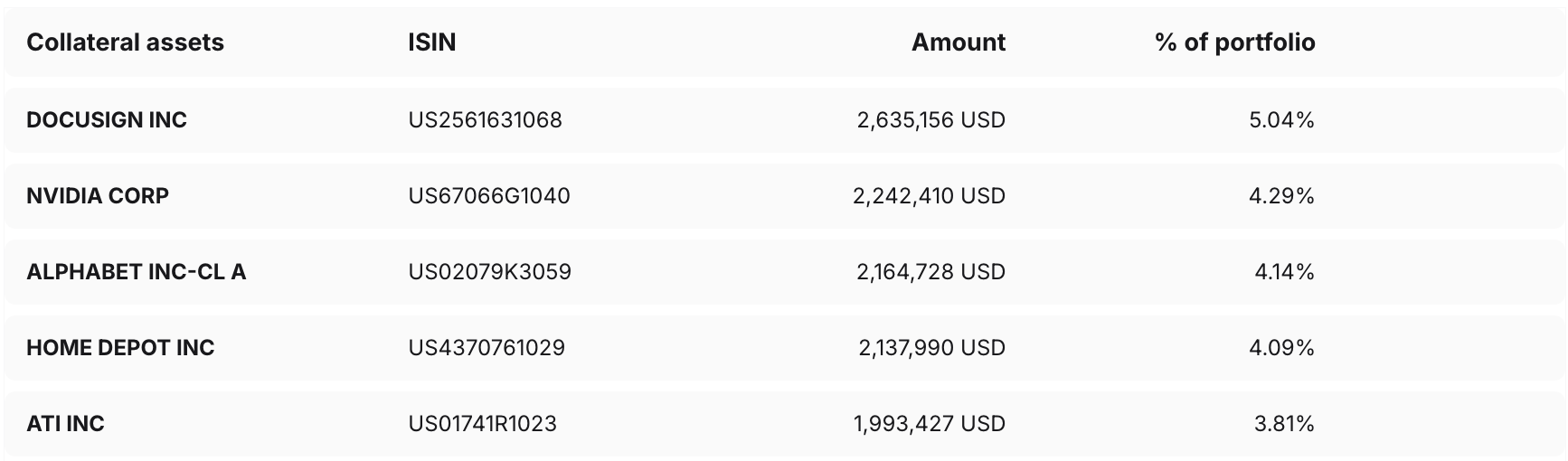
Step 1: The fund invests in a portfolio of financial instruments, primarily shares of large publicly traded companies (from indices like the MSCI World, S&P 500, STOXX Europe 600, and others). These instruments are fully owned by the fund and held securely with our custodian, CACEIS Bank, the Crédit Agricole subsidiary specializing in asset custody and servicing.
Step 2: Alongside the first step, the fund enters into a financial contract with a major international bank. Under this contract, the fund agrees to pass on the daily performance of its portfolio (gains or losses) to the bank. BNP Paribas is Smart Cash’s counterparty.
Step 3: In return, the bank pays the fund a predetermined daily yield as specified in the contract. This yield is set as the risk-free rate plus the agreed-upon spread. The spread is guaranteed in the chosen currency, so there’s no currency risk, even if the underlying securities are denominated in another currency. The yield moves with the risk-free rate, while the spread stays fixed. For example, if the central bank raises its key rates by 0.25%, the fund’s yield rises by the same amount. Conversely, if rates fall, the yield decreases proportionally.
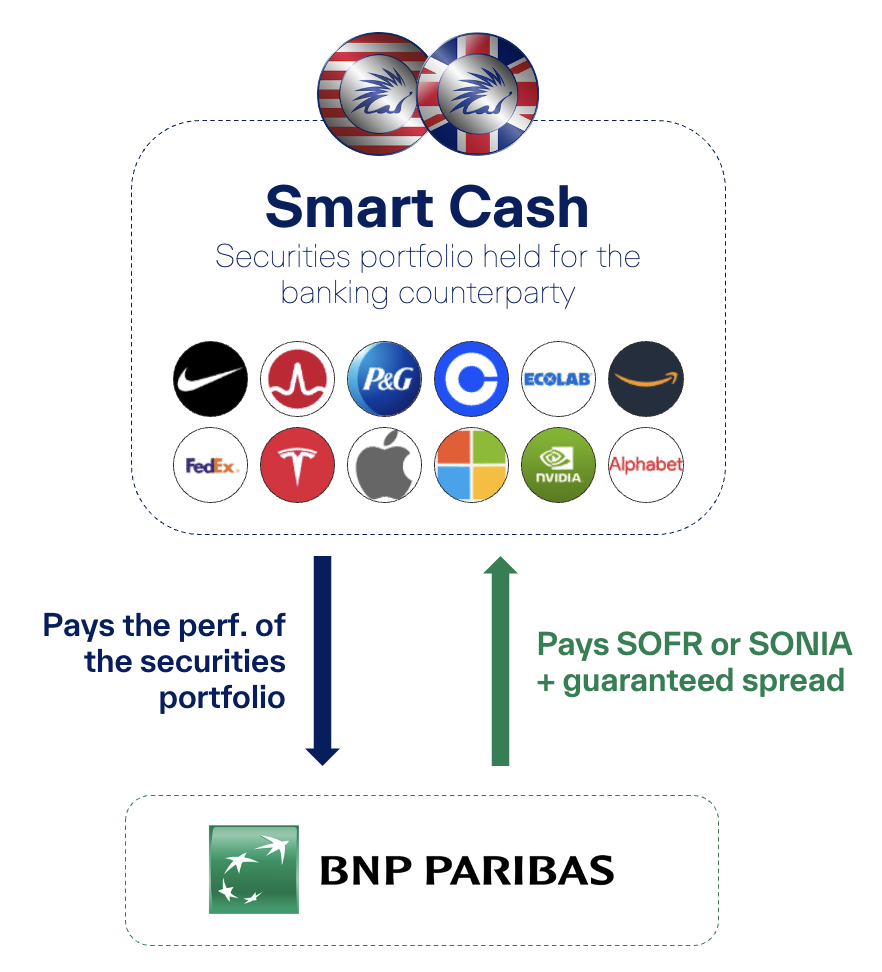
The result? Smart Cash actually holds the shares, but its return doesn’t depend on the stock market at all. The contract between Smart Cash and the bank is called a Total Return Swap (TRS) because it exchanges the full performance of the shares for a predetermined fixed interest. Thanks to the TRS, the fund’s exposure to equities is completely neutralized. For Spiko clients who park their cash in Smart Cash, this means the return is stable, just like a traditional money market fund.
This is the most frequently asked question. The answer comes down to one word: banking regulations.
Here’s where things get a bit technical.
First, it’s important to understand that banks need exposure to equities as part of their business, whether through structured products, ETFs, options, or services for hedge funds. In other words, major banks want to hold shares of large publicly traded companies, like those in the MSCI World, S&P 500, or STOXX Europe 600.
But buying these shares directly increases the size of a bank’s balance sheet. Since the Basel III agreements, banks must maintain a strict leverage ratio, limiting the size of their balance sheet relative to their equity. Holding equities directly therefore comes with a significant capital cost.
This is where the TRS provides an elegant solution: banks get economic exposure to equities (through the swap) without having to buy the shares and expand their balance sheet. In return for this “balance sheet service,” banks pay Smart Cash a daily yield above the risk-free rate.
{{callout-1}}
The spread is what banks pay to optimize their leverage ratio. For Smart Cash, this spread is secured with BNP Paribas through the end of 2027, covering €1 billion in notional.
First, the operation is guaranteed by the counterparty bank. As long as the bank doesn’t fail, there’s no risk. The risk of bank default is very low when the institution is a top-tier bank, such as BNP Paribas.
{{callout-2}}
Next, a mechanism is in place to protect the fund even in the unlikely event of a bank default. This mechanism relies on a key feature: the TRS contract is reset to zero every day (daily reset). At the end of each day, the performance of the portfolio is exchanged between the fund and the bank: if the value of the shares has fallen, the bank pays the loss to the fund, which then buys shares to rebuild the portfolio; if the value has risen, the fund sells shares and passes the gain to the bank. This system ensures that, in the event of a bank default, the fund’s residual exposure is limited to just one day of market variation.
As a result, one could argue that Smart Cash provides additional security compared with leaving money in a checking or term deposit account, beyond the €100,000 deposit guarantee. Amounts above €100,000 are exposed to bank default risk in a regular bank account, whereas with Smart Cash, they benefit from extra protection thanks to the underlying securities portfolio.
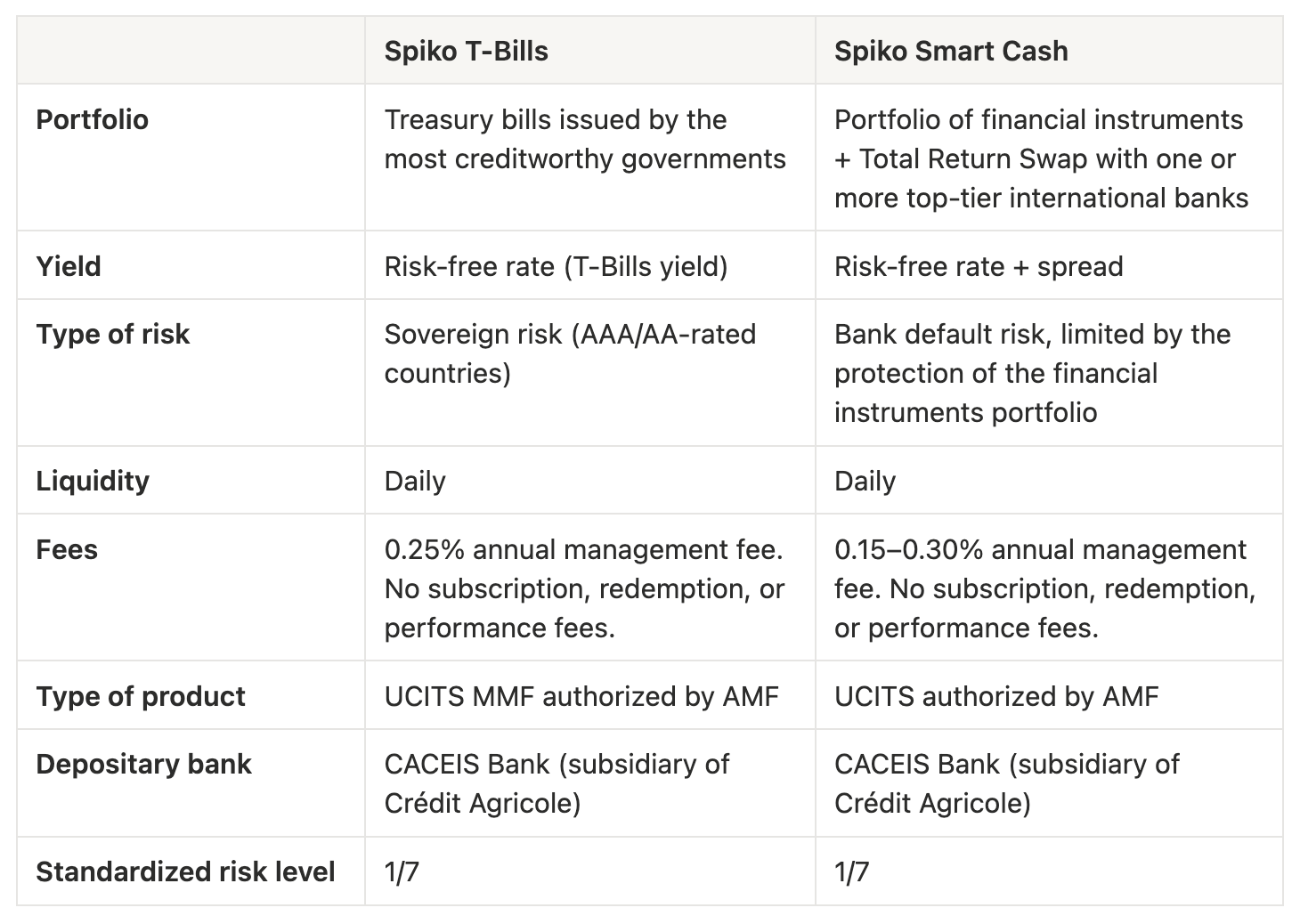
Smart Cash is designed for businesses, institutional investors, or individuals who want to earn a return above the risk-free rate on their cash, while maintaining daily liquidity within a solid regulatory framework. It complements our Spiko T-Bills products: while those focus solely on sovereign assets, Smart Cash offers an extra yield to those willing to take on very limited banking risk, leveraging Amundi’s expertise in Total Return Swap strategies.
If you have any further questions, our team is available to discuss them with you.
At Spiko, we provide simple access to risk-free rates in euros, U.S. dollars, British pounds, and Swiss francs through regulated financial products. Our money market funds hold Treasury bills issued by the strongest governments, while our Smart Cash range offers an enhanced daily return thanks to Amundi’s TRS expertise. Daily liquidity, no notice, no penalties, and no withdrawal fees.
For the curious: how does the leverage ratio work? The leverage ratio measures a bank’s equity relative to the total size of its balance sheet, without any risk weighting. When a bank buys €100 million in shares, that €100 million increases its balance sheet, and it must set aside roughly €3 million in equity to back it. With a TRS, the bank receives the same economic performance, but the exposure recorded on its balance sheet drops to a fraction of that amount, around €0.15 million for the same €100 million notional. This frees up capital for other activities.
The banks that the Spiko Amundi Overnight Swap Fund is allowed to work with are carefully selected according to strict criteria: they must be approved by Amundi’s Credit Risk Committee and have a minimum rating of A‑ (Fitch). In practice, this means only top-tier, globally recognized banks.
To better understand the world of cash management, explore our blog!